I’ve committed to giving my best shot at running a 100k trail race early next year. Here’s my plan to get ready.
The Goal
Run the 100k race as fast as I can in Feb next year.
The route moderately hilly, with 2300m of elevation gain:
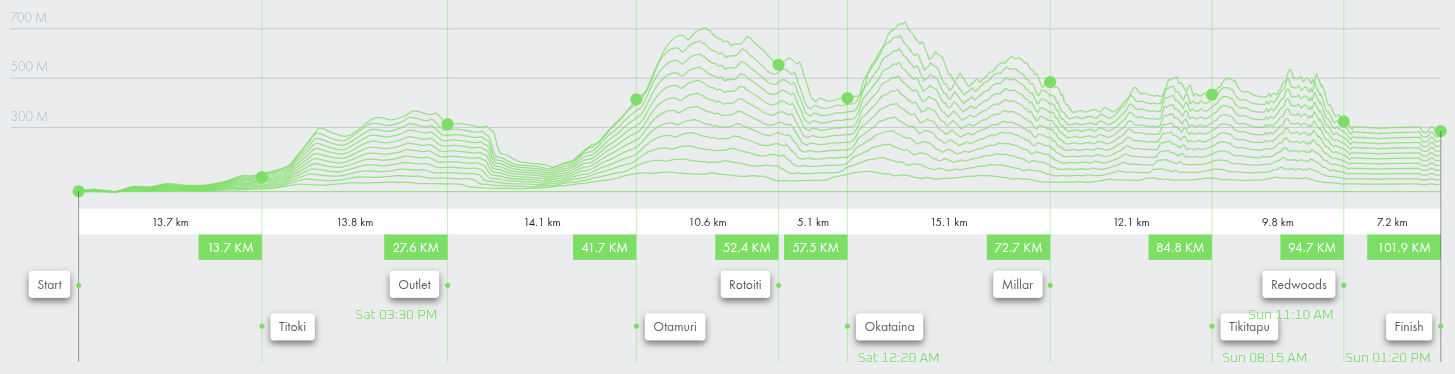
I’ve been running casually for a few years, and I’ve run a 50k before at Mount Kosciuszko. But I didn’t train very hard and it showed, with my quads falling apart 40km in and me hobbling my way to the finish line.
The last time I’ve really pushed myself at running was a 6-month period back in 2016, when I overtrained my hamstrings to the point where I had to stop for several months. I don’t expect to simply eat-sleep-run-repeat my way to this kind of distance.
The Plan
I want my training plan to maximise my body’s rate of adaptation for the race.
How should I adapt? I did some research and asked my running friends for tips. I also aimed to keep it simple and find quantitative measures for each, so I could make this a bit of a science experiment and get a good picture of before/after.
Here’s the list I came up with:
| Adaptation | Measure | How to Improve |
|---|---|---|
| Eccentric quad durability | 20cm step-down reps until failure, after running down Mt Ainslie | Downhill runs, eccentric quad exercises |
| Concentric quad durability | Single-leg 43cm sit-stand reps until failure | Uphill runs, concentric quad exercises |
| Aerobic efficiency | Running pace at an easy heart-rate (135bpm) | Long, slow runs |
| Aerobic endurance | Cardiac drift test, targeting 5:15min/km for 10km | Long, slow runs |
| Fuel tolerance | Max carbs g/h during long runs, without feeling nauseous | Gradually increase consumption rate for each long run |
| Calf durability | Single-leg calf raise reps until failure | Trail runs, ankle & eccentric calf exercises |
Training
To adapt as quickly as possible, I want to maximise the amount of training I can do sustainably.
7-month schedule involving:
- Long slow runs for multiple hours
- Target: 25m elevation gain per km
- Easy runs, multiple days per week
- Interval sessions
- Leg strength training sessions, including
- Weighted step-downs
- Bulgarian split squats
- Standing calf raises
- Seated calf raises
- Romanian deadlifts
- Anterior tibialis raises
- Regular stretching
- Glutes, hamstrings, calves
- Quads, shins
- ITBs
- Peroneal muscles
Load should increase gradually reduce risk of injury. This means increasing distance by no more than 10% per week and dropping occasionally if required for injury recovery.
Loading weekly running progress…
Recovery
- Early nights and lots of sleep
- 160g protein per day
- Prioritise injury healing over weekly distance targets
Progress Indicators
I’m a big fan of High Output Management, which recommends measuring indicators to monitor whether your process is working. In this case I can measure my strength and fitness over time, but also the drivers that might impact the quality of my training or recovery.
I shouldn’t grow too bored of measuring these most weeks:
Outputs
- Resting heart rate
- Pace at 140bpm, observed during long & easy runs
- Cardiac drift %, observed during long & easy runs
- Max carbs/h tolerated without nausea symptoms
- Leg exercise weight & reps
Processes
- Weekly distance covered
- Long run duration
- Weekly elevation gain
- Sleep hours & score
Constraints & Risks
- Heart rate variability
- Injury count & pain score (0-10)
A plan’s a plan until you get punched in the mouth. Let’s see how we go.